THE SUNDAY LETTER · ISSUE NO. 1
Black memory. Christian mystery. The unfinished kingdom.
Good Sunday morning, friends.
I have been thinking about the peculiar temptation to measure Christianity by how much of the world it occupies. How many adherents? How many seats filled? How much political influence? How firmly have we defended something called a Christian civilization?
But I don’t believe the heart of authentic Christianity is to become the most populous religion on earth. Jesus did not say, “By this everyone will know you are my disciples, if you can count them.” He said we would be known by our love.
A kingdom is not the same thing as a market share. A disciple is not a demographic victory. The Church was not called to win a census while losing its soul.
From the Ancient Wells
In Matthew 5, Jesus blesses the poor in spirit, the mourners, the meek, the merciful, the peacemakers, and those who hunger for justice. None of these blessings sounds like a strategy for capturing an empire. They sound like the formation of a different kind of people.
I remain Nicene in confession, contemplative in practice, and kingdom-centered in public witness. Yet the ancient faith is only alive among us if it is made visible in the way we treat the neighbor, the stranger, and even the enemy. We drink from ancient wells. We do not worship the bucket.
Kingdom & Culture
Election nights can be intoxicating. They can make us confuse a temporary majority with a durable movement. In Beyond the Blue Wave, I argue that any hopeful political future depends less on watching the scoreboards and more on building the relationships, habits, and institutions that make ordinary people powerful between elections.
The same caution applies to the Church: we cannot substitute winning for witnessing, or visibility for fidelity.
On the screen: I’ve been watching The Lord of the Rings: The Rings of Power, and what stays with me is the temptation of domination. Sauron doesn’t merely want to destroy; he wants to bring the world under his control, and he can make control sound like healing, order, even beauty. That’s what makes the drama so unsettling. Evil rarely comes announcing itself as evil. Sometimes it arrives offering to save the world—as long as it gets to own the world first.
That feels painfully prescient for American Christianity. We are still tempted to confuse the Kingdom of God with the power to govern everybody else’s life. Defending a Christian civilization can become a respectable name for the very domination Jesus refused. The perennial Christian tradition points me back to an older wisdom: the crucified Christ reveals divine power as self-giving love, not possession. The Kingdom comes as leaven, seed, table, and cross—not as one more ring with which to rule them all.
The Grip of the Raven
I watched The Hunger Games: Sunrise on the Reaping, and I keep thinking about the raven.
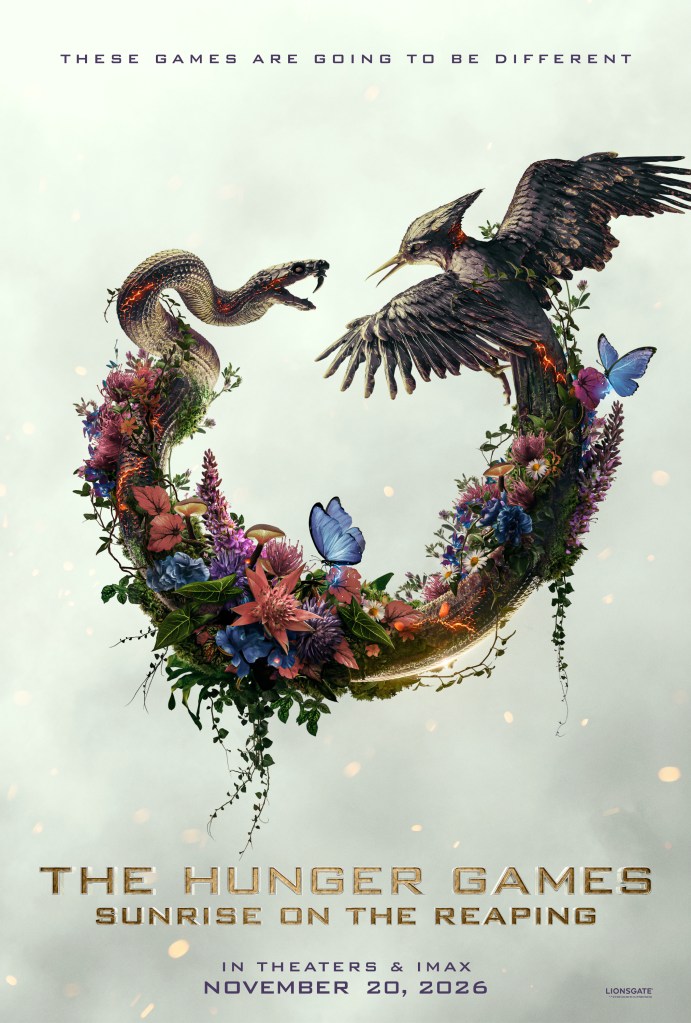
The Capitol doubles the number of children it sends into the arena, then coaches Haymitch on how to make his defiance entertaining. Snow wants him to believe that resistance will cost him everyone he loves. That’s the grip of Poe’s raven. Hear “Nevermore” long enough and you start to believe the bird knows the future.
I thought about Hannah Arendt and what happens when we let slogans do our thinking. America’s authoritarian slide can look painfully ordinary. You glance around before speaking. You laugh along. Everybody waits for somebody else to say what they can all see.
Here’s the cold irony. Christians confess a Lord crucified by imperial power, then do the grunt work of authoritarianism in the name of protecting “Christian civilization.” We supply the Bible verses. We teach people to fear their neighbors. We bless the bargain Jesus refused in the wilderness and call it defending him.
Following Jesus means facing my own appetite for control and my willingness to believe a lie when it serves my side. It also means telling the truth in public and standing beside the neighbor I’ve been taught to fear.
At the end, Haymitch gets to say “Nevermore” about the Games themselves. I thought about Easter. The empire put Jesus in a tomb. By sunrise, the stone had been rolled away.
I want to live in public like I believe it.
And elsewhere in the multiverse: I’m making my way through Marvel Cinematic Universe movies and shows as a lead-up to the premiere of Avengers: Doomsday. Beneath all the spectacle, I keep returning to a decidedly ancient question: what do we do with power? The heroes are most compelling to me not when they can bend the universe to their will, but when they confront their limits, bear responsibility for one another, and discover that sacrifice is more than a dramatic last resort. That’s a perennial Christian question, too. Salvation is not the triumph of the strongest will. It looks more like love freely given, even when love refuses the throne.
In my headphones: I’ve also been listening to a lot of Sigur Rós and old ’80s pop. Strange companions, perhaps. Sigur Rós gives me these wide, almost wordless spaces where longing and wonder can breathe. And then an ’80s pop song comes on—with those bright synths, big melodies, and unabashed feeling—and something in me wakes up. There is a freshness to it, an aliveness. I’ve been nostalgic lately.
Michael Kiwanuka’s new album, FUDGE has been in the rotation, too, and the sounds are stirring. There is something in that music that feels both weathered and alive, something that can hold ache and beauty in the same breath. I hear a kind of longing that doesn’t rush to resolve itself. The perennial Christian in me recognizes that as a spiritual posture: not every encounter with transcendence happens in a sanctuary, and not every prayer arrives with religious words. Sometimes beauty gets to us before our explanations do.
But nostalgia can go one of two ways. It can make us want to imprison the present inside an imaginary past, or it can help us receive the past as a gift without needing to live there. Perennial Christianity teaches me to look for traces of grace and beauty wherever they appear. Not every beautiful song has to be called sacred to become an occasion for gratitude. Sometimes music simply reminds us that we are still capable of being surprised by joy.
Maybe these are connected after all. Domination tries to possess what it loves. Wonder learns to receive it. One closes its fist around the world; the other opens its hands.
Public Witness
In We Moved the Monument. But What About the Memory?, I return to Salisbury and the struggle around a Confederate monument. Moving a statue matters. But it is not the same as dismantling the habits of memory and power that made it seem natural in the first place. The work of freedom is always deeper than the ceremony.
From the Archive
One of the privileges of returning to this journal is meeting an earlier version of myself in its pages. This week I went back to My Name Is, a creative reading of Mark 5 and the man called Legion. The text still presses on me: what happens when we begin naming the powers that possess a people, rather than simply blaming the people living beneath them?
Until Next Week
Here is the question I am carrying into the week: What if the measure of Christian faith were not how many people claimed it, but how much more possible it made mercy, truth, reconciliation, and justice?
Thank you for being part of this conversation. It has been going on for twenty years in these pages, and I suspect we’re only beginning.
With hope and holy restlessness,
Anthony


Leave a Reply